
Why Medical Software Pricing Is So Confusing — A 2026 Practice Owner’s Guide
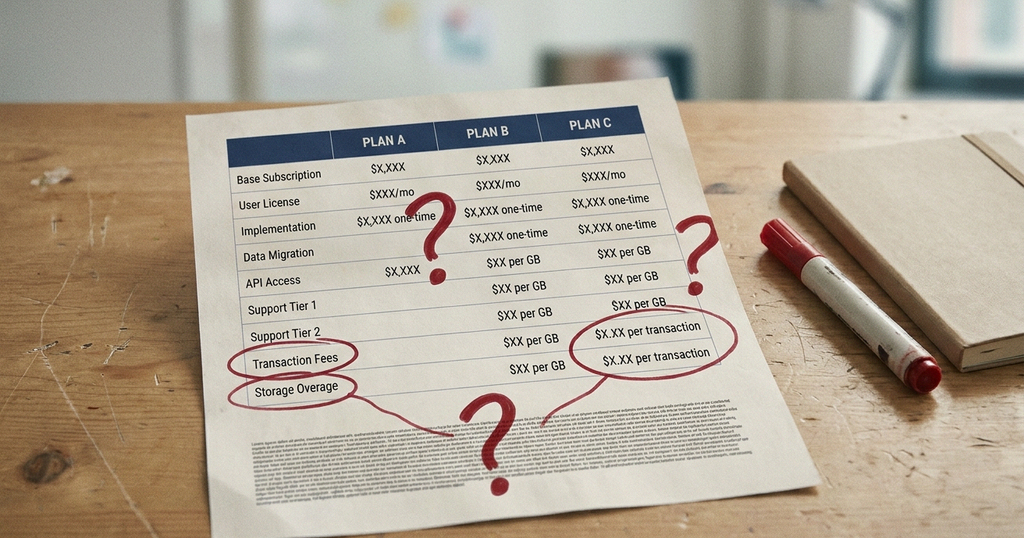
You go to a vendor’s website. You click “Pricing.” You find “Contact Sales for a Quote.” So you book a demo. You sit through a 60-minute pitch. You ask, politely, for a number. They send you a slide deck with a “starting at” price that doesn’t include implementation, doesn’t include training, doesn’t include data migration, and doesn’t include the three integrations your practice actually needs to function.
By the time you have a real number, you’ve sat through five sales calls, your office manager has burned a half-week of evening time, and you still don’t know how vendor A really stacks up against vendor B. You’ve been pulled into the sales gauntlet and you’re still no closer to a decision.
Here’s the thing nobody tells you: medical software pricing is opaque on purpose. It’s not random, and it’s not because the math is genuinely too complex to publish. It’s a behavioral funnel — designed to keep you in 1-on-1 demos where you can’t comparison-shop. Once you understand the design, the whole circus stops looking like normal B2B procurement and starts looking like exactly what it is. This guide breaks down the five hidden cost layers, the real benchmark ranges (the numbers vendors won’t post on their sites), and how to actually compare vendors apples-to-apples.
The 5 cost layers vendors don’t show you upfront
When a vendor shows you a price, they’re almost always showing you Layer 1 only. There are four more layers under it. By the time you’ve signed, the actual year-1 number is often 50–75% above what they led with.
Layer 1: Subscription. Per-provider/month or per-user/month. This is the headline number — the only one most vendors will quote without a 30-minute call. Capterra benchmarks across all medical software categories show roughly $274/month entry-level on the low end and $8,964/month on the enterprise end (Capterra). That’s a 30x spread, which tells you the headline price means very little until you know which tier and modules you’re actually being quoted on.
Layer 2: Implementation. A one-time fee covering setup, customization, configuration of your specialty templates, integrations kickoff, and initial training. This is rarely quoted in the demo. It’s frequently 20–50% of your year-1 cost. For a small practice, expect $5,000–$15,000. For mid-size, $15,000–$50,000. For enterprise hospitals, implementation can run from $500,000 to several million dollars.
Layer 3: Training. Sometimes bundled into implementation, often not. Per-staff training is regularly $500–$5,000 depending on practice size, module count, and whether it’s remote-only or includes on-site days (MGMA). Refresher training when you add staff or modules is almost always extra.
Layer 4: Integration / interface fees. Lab interfaces, e-prescribing, billing clearinghouse, payer connections, patient portal, telehealth module — each one is its own line item. Typical range: $500–$3,000 setup per interface, plus a recurring monthly fee. A practice running labs, e-prescribing, and a clearinghouse can easily stack $4,000–$10,000 in setup costs alone.
Layer 5: Data export / migration / termination. This is the fee that surprises everyone. When you eventually switch — and you will, because no software stays best-in-class forever — you have to get your patient data out. Export fees of $2,000–$10,000 are standard, with some vendors charging more (Black Book Research). Tebra is publicly known to charge around $2,000. Other vendors don’t publish their fee at all and you only find out at termination. If you want to avoid this trap, we cover the data export process and how to keep your records portable in our switching guide.
> Want apples-to-apples quotes for your specific practice? Get Free Quotes →
Why vendors hide pricing (it’s not random — it’s designed)
The first thing to acknowledge: vendor pricing genuinely does depend on practice size, specialty, modules selected, integrations, and contract length. A 25-provider multi-specialty group running labs, e-prescribing, telehealth, and a patient portal is a fundamentally different deal from a solo dermatologist running cash-pay only. So when a vendor says “it depends, let’s get on a call,” they’re not entirely lying. The dependencies are real.
But “contact sales” is also a behavioral funnel. Once you’ve sat through a demo, learned the rep’s name, walked them through your workflow, and started imagining your practice on their software, the switching cost — psychological, not financial — climbs sharply. It gets harder to walk away. It gets harder to negotiate aggressively. And critically, it gets harder to seriously evaluate competitors, because each competitor demands the same investment of time before they’ll quote you. Software Advice data shows that buyers who evaluate four or more vendors and drag past six months hit “decision fatigue and buyer’s remorse” — they stop evaluating rationally and pick whichever vendor’s rep was warmest at the close (Software Advice).
The vendor’s incentive is to get you ONE quote at a time, in isolation, where you can’t comparison-shop effectively. Your incentive is the exact opposite — multiple quotes simultaneously, side-by-side, on your terms. The two incentives are structurally opposed, and right now the vendor wins almost every time because the buyer doesn’t have a way to flip the table.
Real benchmark ranges (the numbers vendors don’t post on their sites)
Here’s what year-1 total cost typically looks like by practice size. These are ranges, not exact prices — your number depends on the five layers above and on which tier of vendor you end up with.
| Practice Size | Estimated Total Year-1 Cost (typical) | |—|—| | Solo (1 provider) | $5,000 – $15,000 | | Small (2–5 providers) | $15,000 – $50,000 | | Mid (6–25 providers) | $50,000 – $250,000 | | Multi-location (25+ providers) | $250,000 – $700,000+ | | Enterprise hospital | $100M – $700M+ |
Sources: Capterra, MGMA, Black Book Research.
The enterprise hospital number isn’t a typo. Memorial Hermann publicly committed roughly $700 million to roll out Epic across 15 hospitals and 250 care sites (Black Book Research). That’s an outlier example, but it tells you something useful — the gap between “small practice EHR” and “hospital EHR” is not 10x, it’s 1,000x or more. Don’t let an enterprise vendor’s language bleed into your small-practice expectations, and don’t let small-practice pricing make you assume hospital systems are within reach.
For most office-based practices, the realistic range is $5,000–$250,000 in year-1 total cost depending on size and module count. The ambulatory EHR replacement market alone is worth roughly $9 billion (Black Book Research) — meaning hundreds of thousands of practices are quietly making this purchase decision every year, mostly with bad information.
The “25% hidden cost” rule
Across most categories, total cost of ownership runs roughly 25% higher than the headline subscription price once you stack the other four layers on top. That’s the conservative estimate. For practices with multiple integrations or heavy customization needs, the gap can be much wider.
Let’s work through a hypothetical 5-provider primary care practice on a mid-tier EHR + Practice Management bundle:
- Subscription: $1,995/month × 12 months = $23,940
- Implementation (one-time): $7,500
- Training (one-time): $2,000
- 3 integrations (lab, e-prescribing, clearinghouse): $4,500 setup + $300/month × 12 = $8,100 year 1
- Year 1 total: $41,540
That’s 74% above the $23,940 sticker price. The vendor’s website said “starting at $399/provider/month” and led with “$23,940/year for a 5-provider practice” — and they weren’t technically lying. They just left out everything underneath the waterline. This is why subscription-only comparisons are useless. You’re comparing the tip of the iceberg to the tip of another iceberg, with no idea what’s below the surface.
Year 2 and Year 3 normalize closer to the subscription number (no repeated implementation, lighter training), but if you switch vendors at year 3, the data export fee resets the cycle. Plan your total cost in 3-year windows, not monthly subscriptions.
How to actually compare vendors apples-to-apples
Once you know the five layers exist, the comparison process becomes straightforward. Here are the rules that get you to a real apples-to-apples decision instead of a sales-pitch lottery.
Rule 1: Demand a 3-year total cost. Not a monthly. Not a year-1. A 3-year total that includes implementation, training, and reasonable integration estimates for your actual stack. If a vendor refuses to quote 3 years in writing, treat that as data — it usually means year 2 and year 3 are where the price punishment lives.
Rule 2: Get the data-export fee in writing. Before signing. In the contract, not in an email from a rep who’ll be at a different company in 18 months. If the vendor charges nothing, get them to write “no fee” on paper. If they charge something, get the dollar amount. This is the single most important clause for protecting yourself from vendor lock-in.
Rule 3: Confirm what’s “extra.” Patient portal? Telehealth? E-prescribing? Patient reminders? Two-factor authentication for staff? Many “starting at” prices exclude features that are table stakes for a modern practice. Build a feature checklist before you ever take a demo, and make every vendor confirm — in writing — which line items are included at the quoted price and which are extras.
Rule 4: Don’t compare on subscription alone. Vendor A might be $200/provider/month with a $40,000 implementation. Vendor B might be $400/provider/month with implementation included. Vendor A looks 50% cheaper on the headline. Over 3 years, vendor B is often the cheaper option. Always do the 3-year math.
Rule 5: Get 2–3 quotes simultaneously. Vendors sharpen pencils when they know you’re shopping. They lead with their best subscription terms. They package implementation more aggressively. They surface migration assistance and concessions they would never volunteer in a 1-on-1 demo. This is exactly what our service exists to do — see how it works for the full process.
> Want apples-to-apples quotes for your specific practice? Get Free Quotes →
Red flags that signal a bad pricing experience ahead
If you see any of these in the early sales process, treat it as a warning that the relationship is going to get worse from here, not better.
- “Contact sales for a quote” with no published starting range, no benchmark guidance, nothing to anchor on
- “Custom pricing” as the answer when you’ve already provided your size, specialty, and intended module list
- Refusal to commit to data migration / export cost in writing before contract signature
- Pressure to sign a 5-year contract for a “discount” that conveniently makes year-over-year comparison impossible
- Aggressive auto-renewal language paired with a short cancellation window (often 60 or 90 days before renewal — easy to miss)
- “Implementation timeline” without staffing detail — no answer to “who from your team will be on-site / available, for how many hours, during which weeks”
- A rep who avoids putting numbers in email and only quotes verbally on calls
Any one of these is a yellow flag. Two or more is your signal to redirect that energy into evaluating a different vendor.
The shortcut — get real quotes from 2–3 vendors at once
The reason the comparison-quote approach works is simple: vendors price differently when they know you’re comparing. They lead with their best subscription terms instead of their list price. They package implementation more aggressively. They surface migration assistance, training credits, and contract flexibility they would never volunteer in a 1-on-1 demo. The same vendor that quoted you $1,995/month over the phone yesterday will quote $1,495/month with implementation included today — if they know vendor B is sitting in your inbox at the same time.
At Compare Medical Software, you fill out a 60-second form, we route to 2–3 pre-vetted vendors who fit your practice size and specialty, and you get apples-to-apples quotes within 1–3 business days. No commitment to buy — you compare the numbers and decide on your terms. It’s free to you: the vendor pays us a referral fee, never you. If you have questions about how that works, our FAQ covers the details.
Stop guessing at prices. Get real quotes for your practice.
60 seconds. No commitment. The vendor pays us a referral fee, never you.